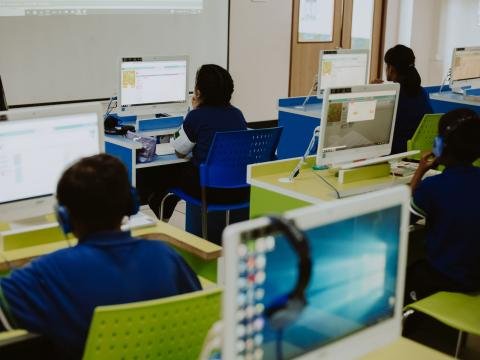

Artificial intelligence is becoming part of how young people search, write, create, and solve problems. That makes access important, but access alone is not enough. Students also need the confidence to question a result, recognize uncertainty, protect personal information, and decide when a human conversation matters more than an automated answer.
AI literacy starts with judgment
UNESCO's AI Competency Framework for Students describes learning across four connected areas: a human-centred mindset, the ethics of AI, AI techniques and applications, and AI system design. The aim is broader than teaching students how to operate a tool. It is to help them understand what the tool does, whose choices shape it, and what responsibility remains with the person using it.
This distinction matters because fluent output can sound more certain than it is. An AI system may produce a polished answer while missing context, repeating bias, or presenting an error as fact. A capable learner therefore asks where information came from, checks it against reliable sources, and explains the reasoning behind a conclusion.
The teacher remains central
AI can help a teacher generate examples, adjust the level of an exercise, or give students another way to explore an idea. It cannot replace the trust, observation, and care that make learning personal. Teachers notice when a student is confused, when a discussion needs more time, and when the class should examine the values behind a technical choice.
UNESCO's guidance for generative AI in education and research calls for a human-centred approach. It also highlights data privacy, age-appropriate use, and careful validation. These principles give schools a practical starting point: technology should serve clear learning goals, and people should remain accountable for the outcome.
What responsible practice can look like
A useful classroom approach gives students permission to experiment while setting clear boundaries. It can include:
- comparing an AI response with books, original research, and trusted reporting;
- marking where AI assisted an assignment and describing how its output was checked;
- discussing which personal details should never be entered into an online tool;
- examining how language, location, disability, and access can affect the usefulness of a system; and
- creating work that shows the student's own reasoning rather than only a final answer.
These habits turn AI use into an exercise in critical thinking. They also reduce the temptation to treat every new tool as either a shortcut or a threat.
Learning for a changing future
The most durable skill is not mastery of one platform. Products will change, and some will disappear. Young people will be better prepared if they can learn new systems, ask careful questions, work with others, and recognize the human effects of technical decisions.
Education can make space for that future without surrendering the values that give learning meaning. When students are taught to use AI with curiosity and restraint, they gain more than digital confidence. They learn how to remain active thinkers in a world where convincing answers are increasingly easy to produce.